Monday, August 2, 2010
FAQ: City Wildlife Ordinance
Bear Smart Durango worked with the the City of Durango on a FAQ and resource guide for the new city wildlife ordinance, adopted by City Council in May 2010.

Saturday, July 10, 2010
DOW Kills Durango Bear That Bit Man
Press Release
7/10/2010
Division of Wildlife
DOW Kills Durango Bear That Bit Man
DURANGO, Colo. Colorado Division of Wildlife officers shot and killed a bear early Saturday morning that bit a man near the Animas River in Durango.
The victim reported he was sleeping outside when he was bitten by a bear through his blanket at about 2:30 a.m. He received a minor wound during the attack and was able to escape the bear by entering into a nearby building.
Officers from the DOW and the U.S. Department of Agriculture responded immediately with tracking dogs, which led officers directly to a male bear approximately three blocks from where the incident took place. DOW officers shot and killed the animal. The bear carcass was identified by several people who witnessed the incident as the bear that bit the man.
"A bear that bites a person - or loses its fear of people may be a serious threat to public safety," said Patt Dorsey, area wildlife manager for the DOW in Durango. "In the interest of public safety, we chose to remove this animal as quickly as possible."
The carcass of the bear that was killed by DOW officers underwent a necropsy at Colorado State University. The stomach contents of the bear demonstrated that the bear was using human-provided food sources. This is almost always the case with bears involved in human conflicts. A package of hamburger and an ice cream-container were found in the bear's stomach.
There are several transient camps in the area of Durango where the attack occurred. These camps can attract bears due to easy access to trash and food.
Tuesday, June 29, 2010
City of Durango Wildlife Ordinance

On May 18, 2010, the Durango City Council passed, in a 4-1 vote, a city wildlife ordinance meant to reduce the availability of trash to bears and other wildlife. The ordinance went into effect in late May.
In a nutshell, if wildlife is not getting into your trash, nothing is required of you. However, in the event that your trash gets strewn, you will be required to store your trash in a secure location or 2) obtain a wildlife-resistant or wildlife-proof trash container, and 3) abide by hours of container placement rules.
The ordinance is complaint-driven. Bear Smart Durango encourages residents to report any bear-strewn trash immediately to City Code Enforcement at 375-4930.
The feeding of wildlife is also addressed in the ordinance. You can download a copy of the ordinance here.
Monday, June 28, 2010
Chama NM bear
Neat bear sculpture in downtown Chama, NM. June 2010. (Click on photo for a larger view).


Wednesday, June 16, 2010
bear-proofing photo examples
Examples of wildlife-resistant and wildlife-proof trash containers available in our area. (Click on photos for a larger view).

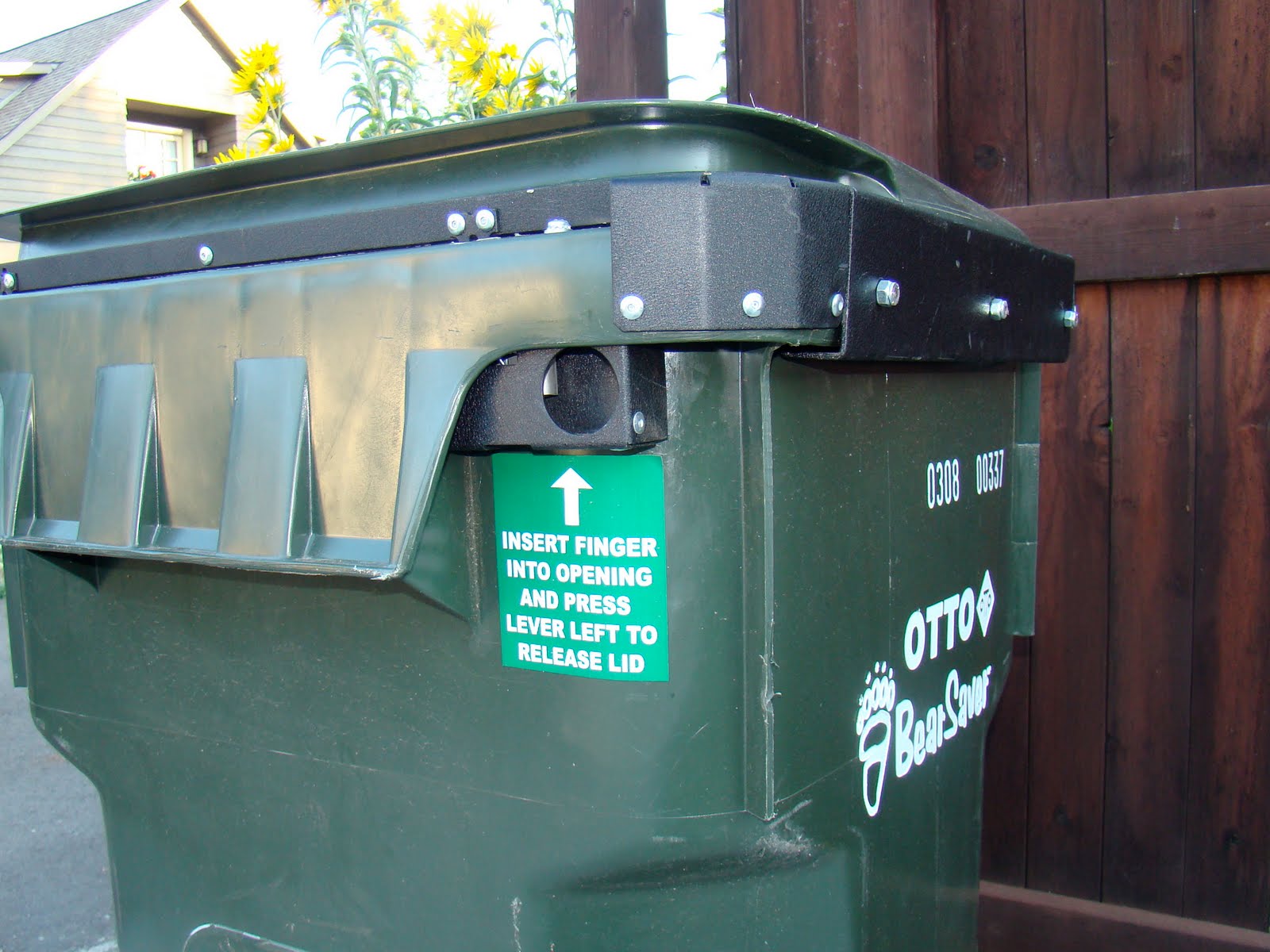
Example of wildlife-resistant trash containers available for for county residents via Waste Management and WCA Transit Waste. (WM shown here).

One size of wildlife-proof dumpsters available from WCA Transit Waste. Phone: 247-0646

A couple examples of wildlife-proof dumpsters available from Waste Management. Phone: 247-1821


Dumpsters available from the City of Durango Department of Sustainable Services. Phone: 375-5004.


Saturday, May 8, 2010
a couple recent pics
Here are a couple recent bear-related pics from the area.
A reportedly BIG bear got into trash near Ball Lane, Sat. May 8th. The friend that reported this is looking into wildlife-proof dumpsters from either the city, WCA Transit Waste or Waste Management to replace the current city-provided 300-gallon containers.

A bear got into a dumpster and damaged a garage door off CR 234, Friday, May 7th. The owners plan to have Waste Management swap the plastic lids out for metal wildlife-proof ones.


Feed set out, presumably to feed ducks, off Junction Creek.

Wednesday, March 31, 2010
a bear story
While walking my dog in March, I found a dead bear. More precisely, the skeletal remains of a bear. The bear had most likely been hit by a vehicle and made its way partly up the steep hillside off US Hwy 160 before expiring. Two faded, blue ear tags dated 2005 and numbered 75 were lying next to the sun-bleached skull.


That’s not even the weird part.
The Colorado Division of Wildlife was nice enough to invite me in 2005 to see the process of relocating a bear from its capture site. The bear I saw, a female, was one of two captured in Rafter J, after causing property damage to storage sheds and a vehicle, all of which contained food.


I have photos of the other bear, a large male, in educational presentations I make to the public. That bear, transported and released well north of Dolores, sported two blue ear tags - dated 2005 and numbered 75.


 In my talks, I mention that black bear relocation feels good and people demand it be done. But relocating bears is a band-aid approach to bear-human issues. Relocation has better success in younger bears more open to a change in behavior. (Anyone that's trained dogs knows training a puppy has better success than trying to correct bad habits in an older dog set in its ways).
Studies have shown that around 85% of black bears relocations fail, as bears moved to unfamiliar habitats continue their problematic behavior in a new location, get killed by other bears or most likely, make a beeline back home to the habitats they grew up in and know best.
Bear “2005-75” is an example. This bear made the 50+ miles back to its original home range only to, probably, meet its fate with the front end of a vehicle on a dumpster-laden stretch of US Highway 160. Bear “2005-75” was, at a minimum, twice a victim of bear-human conflict.
Bear “2005-75” is an example. This bear made the 50+ miles back to its original home range only to, probably, meet its fate with the front end of a vehicle on a dumpster-laden stretch of US Highway 160. Bear “2005-75” was, at a minimum, twice a victim of bear-human conflict.
Instead of demanding that a state agency solve problems we’re creating maybe we should focus efforts on not attracting bears with foods, (like food stored in sheds and vehicles for instance), in the first place. Just a thought.
Bear relocation photos courtesy: CDOW, 2005.
Subscribe to:
Posts (Atom)